
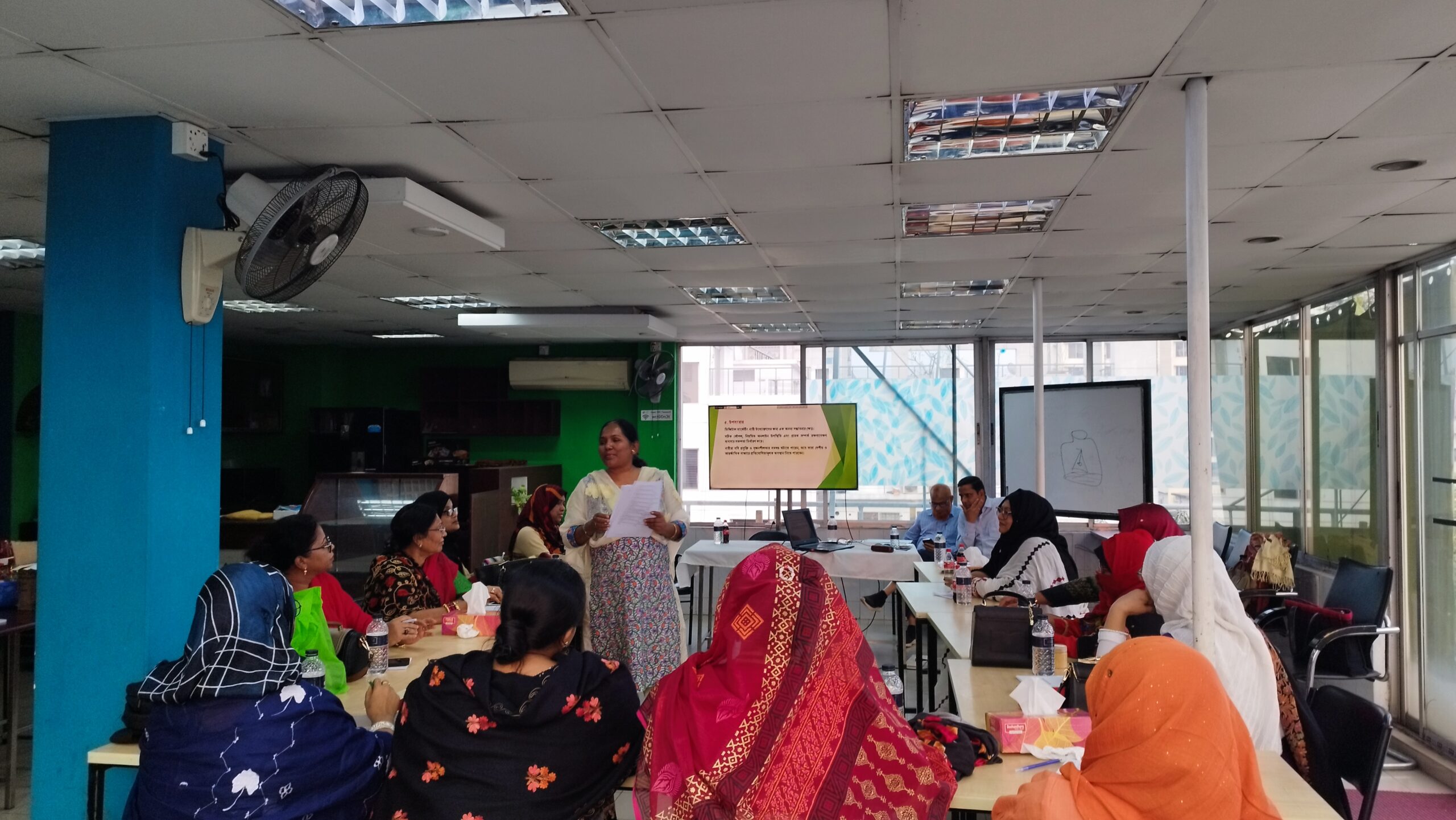
Project Location: Jashore, Dhaka, Savar, Manikganj, Gazipur, Chapainawabganj/Rajshahi, Chattogram/Rangamati, Sylhet, Rangpur, Mymensigh, Munshiganj & Narshingdi
Project Authority: Ministry of Commerce
Financier: World Bank
Project Background: The Government of the People’s Republic of Bangladesh has received an SDR 150 million credit from the International Development Association (IDA), a member of the World Bank Group, for financing the cost of the Bangladesh Regional Connectivity Project 1 (BRCP-1), being jointly implemented by the Bangladesh Land Port Authority (BLPA), the National Board of Revenue (NBR), and the Ministry of Commerce. Under the BRCP-1 sectorial training has been provided to women entrepreneurs for 3 sub- sectors – Agro processing, Cut Flowers and ICT. As of August 2024, 1125, 1000 and 1000 women entrepreneurs have taken a 5-daylong sectorial training on Quality Production, Processing, Packaging and Business Development in the Agro-processing, Cut Flower and ICT sub-sector respectively. From these trained women entrepreneurs’ 1000 potential individuals were provided with a 6-daylong training on Trade Regulation issues. Accordingly, 600 women entrepreneurs having received sectorial training on Agro-processing and Trade Regulation issues were engaged in the training batches on hands-on Agro-Processing, Packaging and Business Development under the Piloting Activities. Similarly, 270 women entrepreneurs having received sectorial training on Cut Flower and Trade Regulation issues were engaged in the training batches on hands-on Cut Flower Processing, Packaging and Business Development under the Piloting Activities. A total of 870 women entrepreneurs received training under the piloting activities. The objectives of this assignment are to develop a training curriculum and implement refresher training on agro/cut flower processing in order to enhance involvement of women entrepreneurs in the business under the mentioned sub-sector
Actual Services provided by SAMAHAR:
Component-1: Development and designing of training curricula/module
- Develop curriculum/module for 04 (Four) days training in mechanized processing, business and regulatory issues.
- Develop updated curriculum, modules and manuals based on the existing references/publications (to be identified by the client) and validate the same through workshops individually by sectors (Cut Flower/Agro-Processing) in presence of relevant stakeholders.
- The training sessions includes 25% theoretical and 75% practical/learning by doing.
- Ensure necessary arrangements for practical/learning by doing sessions.
- Conduct 03 days ToT for trainers before the training.
- Product wise selection of participants/preparation of trainees list.
- Implement 01 (one) batch piloting on the curriculum/module developed prior to implementation of the training program. SAMAHAR includes the following agendas in training modules.
- Identification of trainers’ qualifications, scope of training.
- Develop training schedule and metrics to measure progress.
- Develop pre-training and post-training trainee knowledge assessment toolkit
- Develop a mechanism to receive trainee’s feedback and complaints anonymously.
- Develop an independent monitoring and evaluation mechanism for training.
The training includes on the farm/shop (real life) training, including role playing workshops to build capacity to increase sales.
Component-2: Implementation of training
- Deliver training in an inclusive and participatory way which includes real life practical sessions, as necessary for complete understanding about the subject/technology etc.
- Trainings encourage open debate in the class.
- Trainings bring to the discussion as much as possible women leaders for the students to interact with and learn.
- Trainings conclude by receiving formal feedback from participants.
- After the training, the trainers work with each participant to identify few customized actions that they would like to grow their involvement in the agro- processing/cut-flower sector.
- After the training, an assessment report on further needs of participants including, but not limited to, logistics, infrastructure needs (like cold storage), marketing support, financing, additional trainings, and so on submitted by SAMAHAR. The final reports based on the feedback/suggestions of the trainees.
- After trainings, two refresher workshops for participants organized to address any questions that might arise during implementation of the training in real life.